Orbit 36
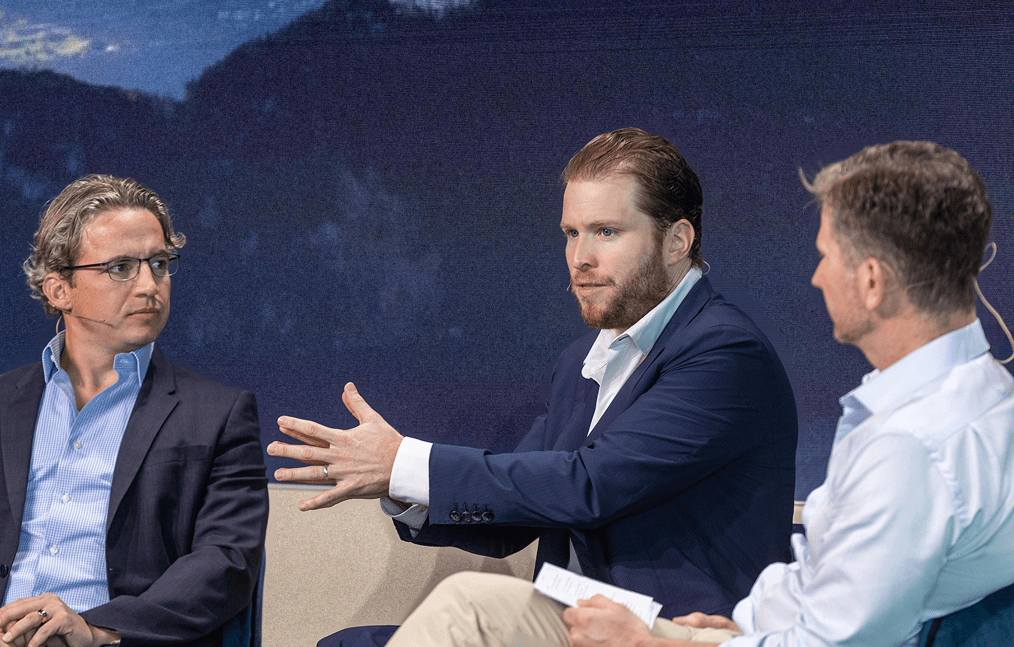
Born of the same crucible as Reid Hoffman, Peter Thiel and Elon Musk, Joe Lonsdale and Eric Poirier have been building and investing in software for over two decades. As the General Partner of 8VC and the CEO of Addepar respectively, they have seen industries evolve and innovate. Speaking at Hg's recent 'Software Leadership Gathering', Matthew Brockman asked them - since software has allowed new entrants to compete with the old guard - what areas could AI open up? Applying AI to existing technologies and services is one approach but it is one that comes with a level playing field and broad competition. Ask yourself the question: what's only just become possible now that hasn't been possible over the last few years and invent something new.
Born of the same crucible as Reid Hoffman, Peter Thiel and Elon Musk, Joe Lonsdale and Eric Poirier have been building and investing in software for over two decades. As the General Partner of 8VC and the CEO of Addepar respectively, they have seen industries evolve and innovate.
Transcript

Matthew Brockman
I'm not going to embarrass you guys. But if we could do just a quick, quick bio. Perhaps. Just so people kind of know who you are. So Joe is founding partner of 8VC, obviously big venture capital firm, partners with a lot of founders and entrepreneurs. Began his career working with Peter Thiel in Paypal while an undergraduate at Stanford. Then went on to work with Peter Thiel’s Clarion Capital and then, I think, about the age 21/22 forms Palentir which we can foresee now growing to a 60 billion dollar EV business. Obviously, a number of startups. So Joe’s been responsible for a number of businesses that hit, you know, a billion of value and frankly, way beyond. And is now working that through the the AVC platform. I would say part of the Paypal mafia, if that's still allowed to be described. That also includes, you know Peter, Elon Musk, Roelof Botha, Reed Hoffman, etc, etc. And I thought it was particularly important or interesting to hear from Joe around how he thinks about, you know, industries revolving, how you build software that serves those industries. How that, how that goes through Eric, is CEO of one of the major companies that that Joe's founded, Addepar Addepar works with hundreds of financial advisors. I think you're up to about 6 trillion of AUM now on the platform. This business is frankly revolutionizing, changing the way that wealth management works globally, you know. Very arcane industry, very poor data, very poor customer experience. And Addepar is now frankly established as being, like the leading platform, is going to frankly take enormous market position, already has, and is going to continue to grow that time. And I think you've been there since 13 years or something. It's been a it's been a long journey. So you've been right the way through the journey in terms of where this come from as a small company with minimal revenue and a lot of losses, and taking that through the journey. So, I thought it was very interesting to kind of get that perspective when you're thinking about some of these end industries that look very stable, frankly, slightly boring. How do you think about innovation product innovation in that in that context. So, Joe, if I can start with you. You've built Addepar. You've built Palantir. You've worked in local government. There's a bunch of these market spaces. You've done stuff in trucking. It's very interesting, this sort of you know. You'll you'll the conventional idea of, you know, you build technology which is in these kind of high growth sexy areas, you'll almost paying a counterplay and with a very long term horizons. Basically business running 15, 20, 30 years. I'd love to kind of open a bit on. How do you think about where you spend your time? How do you build innovation. What are you looking for? How does that process work?

Joe Lonsdale
Sure. Well, thanks for having me. It's good to see you guys you know, in in in my part of the world, which is a little bit different. We write a lot smaller checks than you guys and and start at the beginning. And there's really 2 big things we're looking at. One is we need to work with the very best technologists in the world, because these these things are very hard to build. So we spend a lot of our time tracking talent and trying to trying to trying to build teams yet again, like the early paypal team where you had all of Peter Thiel and Elon Musk start as friends. I think we achieved that at Palentir and Addepar. So that's the whole talent game. And then 2, which maybe is intellectually more interesting is really a question of what's possible now that wasn't possible 5 years ago. So if you wanna build a multi-billion dollar company, you probably shouldn't be doing something that people could have done 10 years ago, because it's it's gonna be very, very tough. And so the, without going too far back in history, I think the the really big wave is started around 2009/2010, which is when Addepar got going, was what we call we call it the Smart Enterprise Wave, because you're go… It was really the cloud big data wave. Because what was happening is that for the 1st time we're going back and replacing a lot of companies that were started in the seventies, eighties, nineties: your pre-internet companies. And most of didn't really have great tech cultures. And you were able to do that. And it was worth ripping out the old infrastructure in so many areas of the economy because of the cloud. Right? So you probably had about 600 of these, you know, multi-billion dollar companies started right around this like 7/8 year period, because all of a sudden it was possible to go fix this stuff from 30/40 years ago. I think if you're saying today in 2024 is interesting question like, How do we now build another company of the size of Addepar. You probably aren't gonna just use AI to compete with Addepar, because Eric's using AI too, by the way, that's gonna be very hard, because he has hundreds of millions of dollars to invest into into what he's doing. So the question is like what's possible in the the area that I just that I'm most bullish on now that relates to this is really going back. And, by the way, when we say we started Addepar and OpenGov and Blend and all these companies, it it sounds very impressive, but it's really, actually not that impressive. We had access to the best tech cultures, and we were kind of being bullies. We're beating up on these 30/40 year old poor companies that couldn't couldn't, you know, couldn't make it anymore relative to us. The question is, how do you do that? Now? In in? I think the area is the AI unlocks is, there's a lot of companies started 50/60 years ago, even that are doing services that suddenly we can now go compete with the technology which you couldn't have done 5 years ago. So that's my high, level model of how I think about it.